Features

Feature modules built around a clear storefront flow and cleaner production handling.

The product is organized around setup, storefront UX, AI styles, selling logic, and production output.

Guided tour

Feature flow with real screens

Each stage below maps to a real part of the designer so merchants can understand where upload, AI, sizes, discounts, and production logic actually happen.

Product setup and live product selection
Step 1 Desktop view

Product setup and live product selection

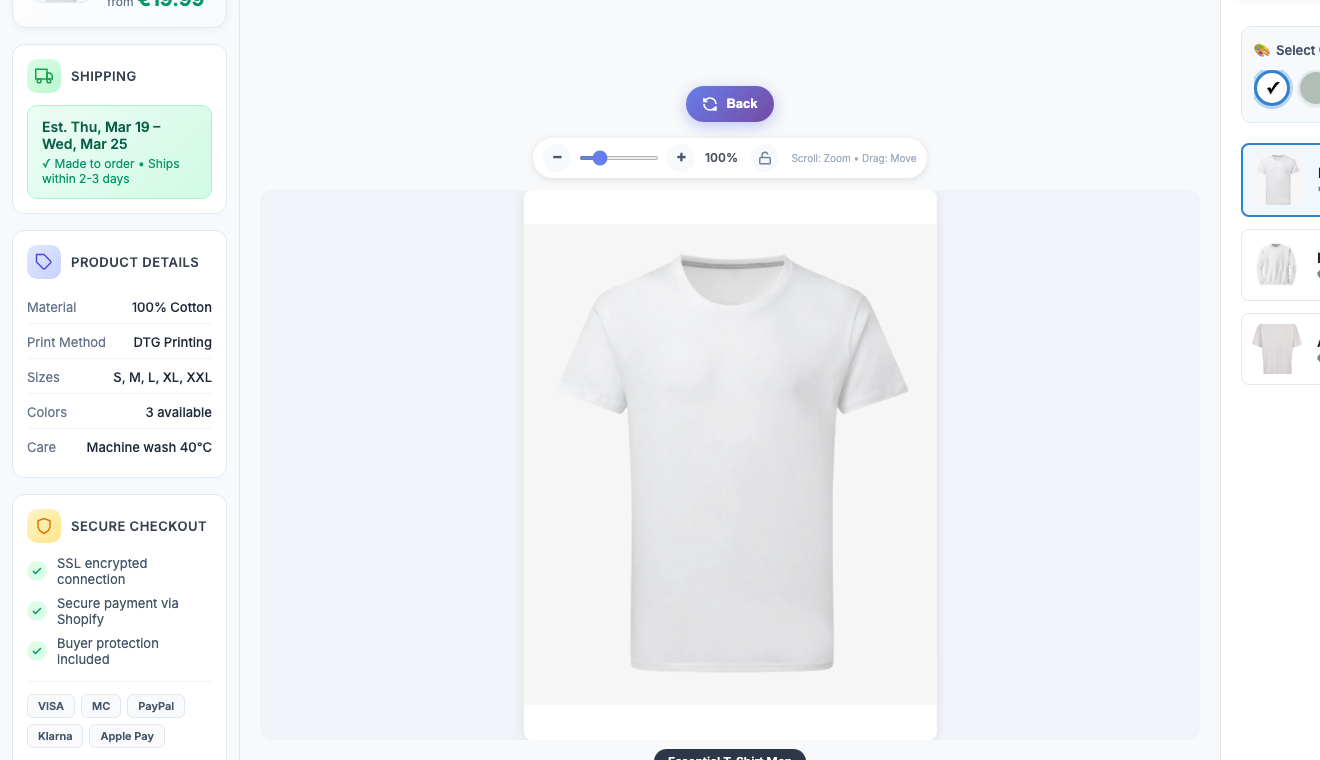
This is the entry view on the storefront. It keeps product choice, color selection, pricing context, and the next step visible without overwhelming the shopper.

Live product switchColor optionsStock-linked setup
  • The merchant connects an existing Shopify product instead of rebuilding the catalog in a separate system
  • The storefront shows product choices, color selection, and active item details in a clear product-first layout
  • Live stock, product data, and product switching stay tied to the Shopify setup behind the designer
Upload, text, AI image styles, crop logic, and design controls
Step 2 Design step

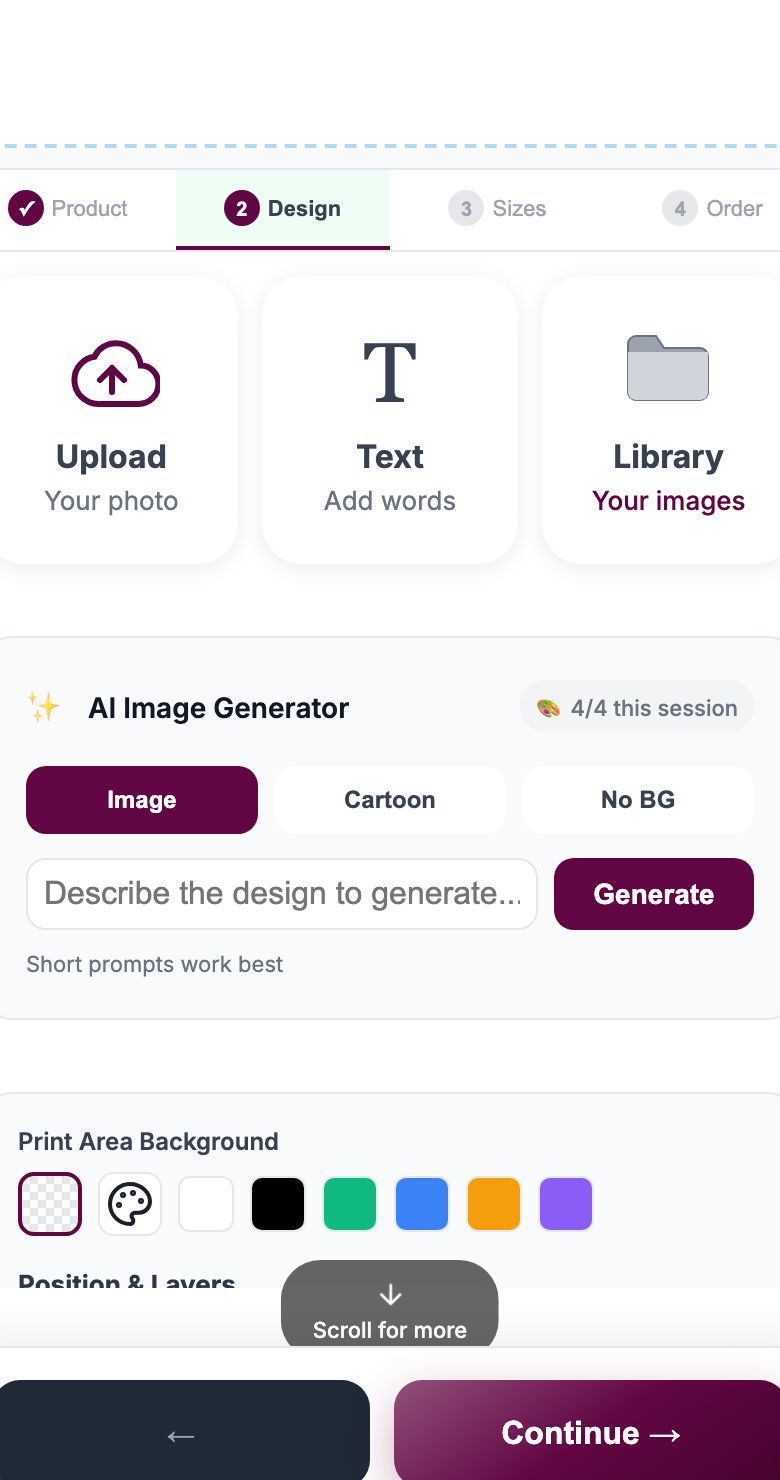
Upload, text, AI image styles, crop logic, and design controls

This screen is where personalization actually happens. Upload, text, AI actions, and positioning tools are grouped into one focused workspace instead of being spread across multiple panels.

UploadTextAI stylesNo BGLayers
  • Customers can upload an image, work with their own library items, or add custom text from the design step
  • AI image generation, style actions, background removal, crop handling, zoom behavior, and layer positioning stay inside one guided screen
  • This keeps design choices visible and simple on mobile instead of scattering tools across a cluttered editor
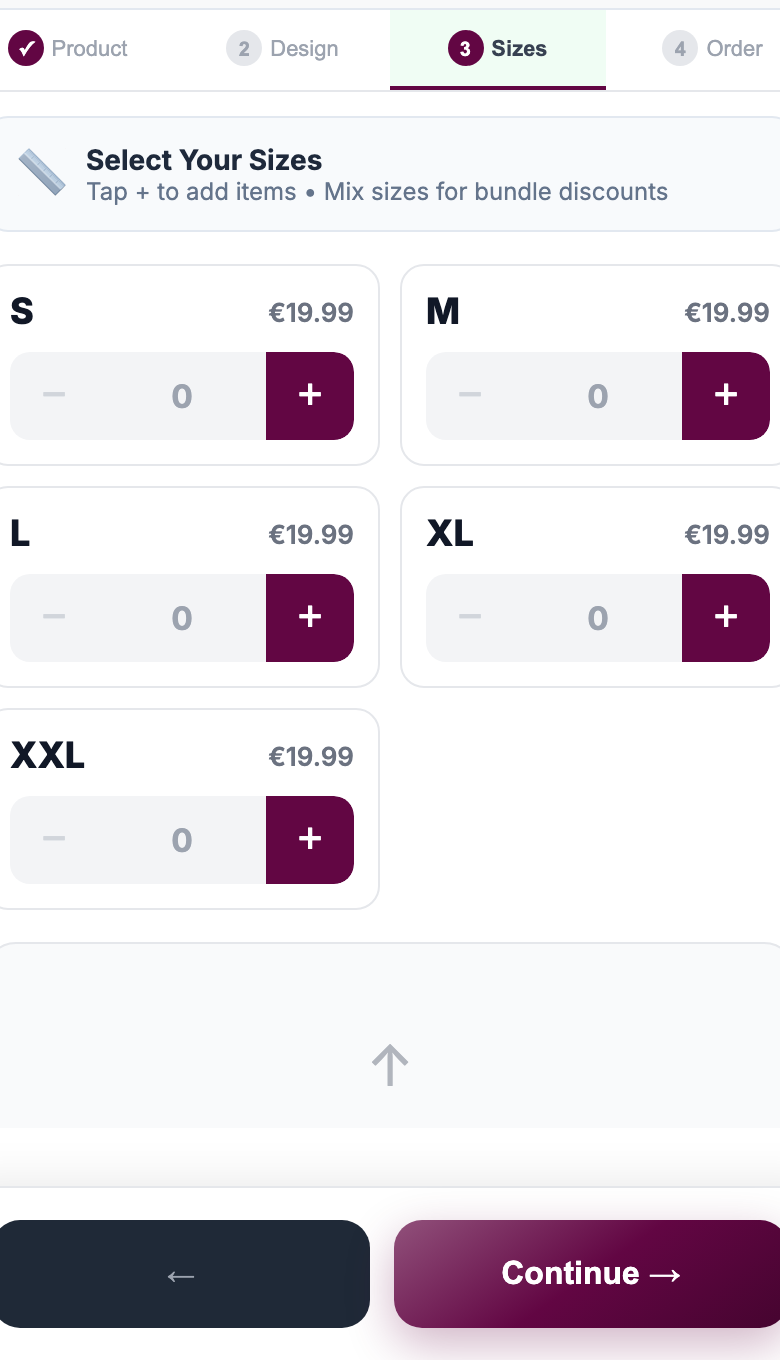
Mobile-friendly size, quantity, discount, and upsell flow
Step 3 Mobile flow

Mobile-friendly size, quantity, discount, and upsell flow

The size step is designed to help conversion, not just collect options. Quantity selection, discount thresholds, and the continue action stay obvious on a small screen.

SizesBundle discountsTouch-first controlsUpsell-ready flow
  • The same step logic works on mobile with touch-friendly size controls and a clearer continue path
  • Size and quantity choices can support bundle discounts directly in the buying flow, with thresholds shown to the shopper
  • Alternate products, related options, and upsell logic can be introduced as part of the order journey instead of as disconnected popups
Merchant control and print-ready production output
Step 4 Admin + output

Merchant control and print-ready production output

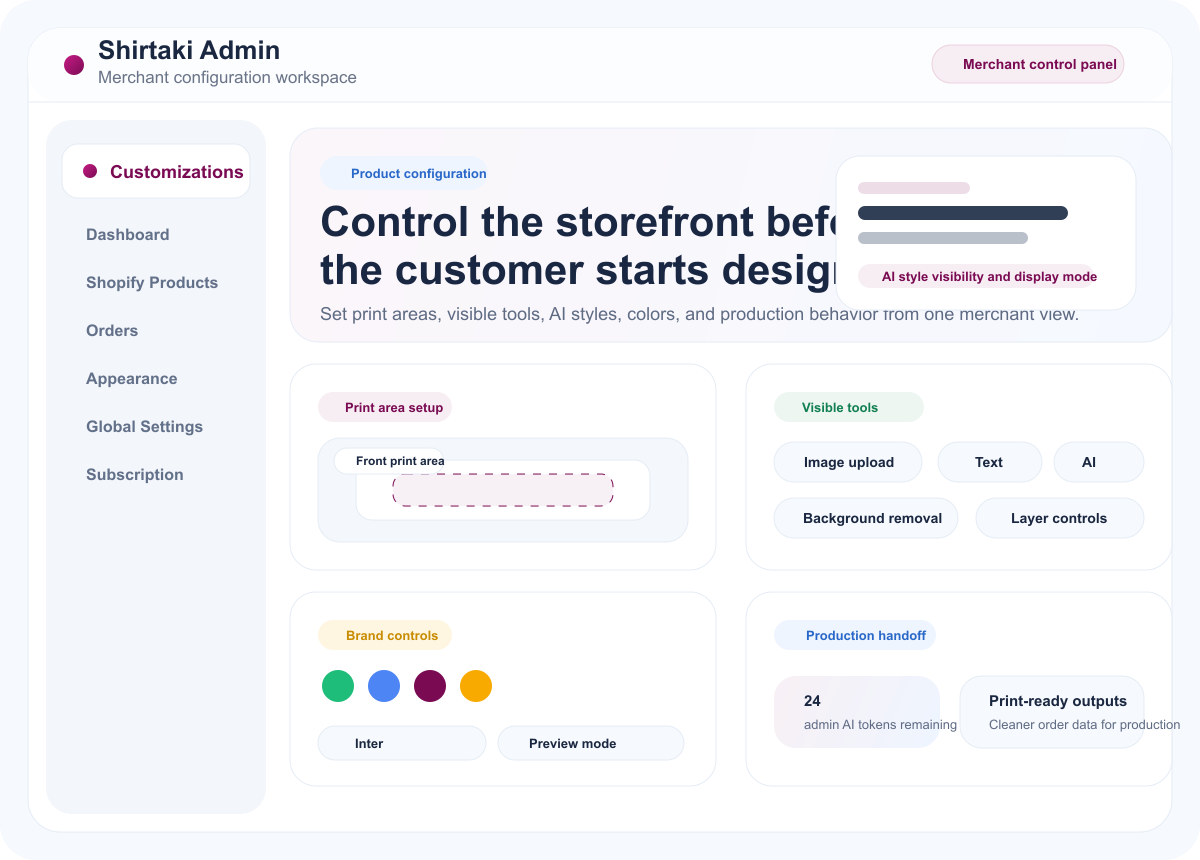
On the merchant side, the designer behavior stays configurable. Teams decide which tools are visible, which AI styles are enabled, and how the customer experience should behave before production starts.

Tool visibilityAI style controlsBrand colorsProduction-ready output
  • Merchants control visible tools, available AI styles, colors, brand behavior, and design logic from admin
  • After checkout, the order can move into print-ready output instead of manual recreation work
  • This keeps the shopper flow simple while giving production teams cleaner files and order data

Merchant control

Merchant admin panel

The merchant side is not just a settings dump. It is where the storefront behavior, AI style availability, print areas, brand controls, and production readiness are managed in one workspace.

Merchant admin panel

Admin controls

Visible tools, AI style settings, print areas, brand controls, and production logic are managed from one merchant workspace.

Why it matters

Configure the storefront before the customer starts designing

  • Control which tools customers see in the designer
  • Choose which AI styles are visible and how they are presented
  • Set print areas, brand colors, and storefront behavior before launch
  • Keep the production handoff aligned with the storefront setup

UI view

Additional interface views

These screens show the live storefront and the merchant-side control area from a lighter summary view.

Desktop storefront flow
Frontend

Desktop storefront flow

A real desktop view of the designer with side panels, color selection, and product switching.

Design tools on mobile
Design

Design tools on mobile

The real design step with upload, text, AI image generation, background removal, and layer controls.

Sizes and bundle discounts
Sizes

Sizes and bundle discounts

The live size step keeps quantity selection simple and shows discount thresholds directly in the flow.

Admin controls
Admin

Admin controls

The merchant side controls which tools are visible, which AI styles are available, how the designer looks, and what reaches production.

Module

Product Setup

What it does

Connect an existing Shopify product and configure print areas, product views, options, variant relationships, and customization rules.

Why it matters

Merchants should not need a separate catalog or a custom build to launch personalized products.

Merchant outcome

Faster launch of customizable products on top of the products already selling in Shopify.

Operational outcome

A more structured setup for what the customer can edit and what production needs to receive.

Module

Storefront Customization

What it does

Add a storefront entry point that lets customers personalize the product, add text, choose styles, and move through a guided flow.

Why it matters

Customization only converts when the user flow is understandable and feels native to the product page.

Merchant outcome

Higher confidence at add to cart and a clearer path to selling premium custom products.

Operational outcome

Cleaner order inputs because customers are guided through a controlled designer experience.

Module

AI Design Tools

What it does

Offer managed AI style options such as cartoon, halftone, sticker, or other predefined transformations, alongside background removal and quality checks.

Why it matters

Many customers need help producing artwork that looks intentional and is usable for production.

Merchant outcome

A more compelling customization experience without asking customers to arrive with perfect artwork.

Operational outcome

Better starting assets and fewer low-quality submissions reaching production unchanged.

Module

Production & Print Files

What it does

Generate print-ready outputs after the customer completes the order so the merchant or print team can download and produce.

Why it matters

A customization tool without production output still leaves teams doing manual prep work.

Merchant outcome

A more complete workflow from product page to manufacturing handoff.

Operational outcome

Less repetitive artwork preparation and more consistent production handling.

Module

Upsells & Conversion Features

What it does

Configure upsells, alternate product options, and quantity-based incentives around the customization workflow.

Why it matters

Customization can increase margin, but the commercial structure also needs to improve AOV.

Merchant outcome

More revenue opportunities from a single customized order.

Operational outcome

A configurable way to present add-ons and volume logic without ad hoc manual selling.

Module

Admin Tools

What it does

Use operational tooling for product views, alternate colors, product support, and merchant-side production coordination.

Why it matters

The app has to be manageable after launch, not only attractive during the first demo.

Merchant outcome

More control over the customer experience and less reliance on manual intervention.

Operational outcome

A backend that supports repeatable production workflows and product maintenance.

Module

Scalability for More Product Types

What it does

The system is designed to extend beyond shirts and hoodies into home goods, stickers, engraved items, furniture, and other customizable categories.

Why it matters

Merchants and print operators often expand product lines once the workflow proves viable.

Merchant outcome

A path to grow customization beyond a single merch category.

Operational outcome

A platform direction that supports broader production use cases over time.

Next step

Need to see how the modules connect in sequence?

The workflow page shows how product setup, storefront customization, and production output fit together.